L&L · Minna Agency
Motherless BrooklynL&L / Minna Agency is Frank Minna’s Brooklyn enterprise, successively presented as a moving company, a car service, and a detective agency. Its changing business labels conceal and enable work that ranges from hauling furniture to surveillance and politically charged errands. The organization also gives a group of boys from St. Vincent’s Home for Boys a place in Frank Minna’s world: first as underpaid labor, then as agency men whose access to neighborhood life becomes a tool of investigation. By the end, L&L retains the car-service name but begins a more consequential transformation, operating as a real service and a detective agency that is clean for the first time.
Formation as a Moving Company
L&L begins with an insistence on what its work is called. Frank Minna gives Lionel Essrog, Tony Vermonte, Gilbert Coney, and Danny Fantl twenty dollars apiece and business cards announcing L&L Movers, with Frank and Gerard Minna named on them. When Tony asks which Minna he is speaking to, Frank identifies himself; the company’s simple public identity is part of the lesson. Whatever else the boys may suspect, their job is moving. The modest payment and cards establish the four as junior staff, while Frank’s irregular summonses keep them waiting at St. Vincent’s after school for the grumble of his van.
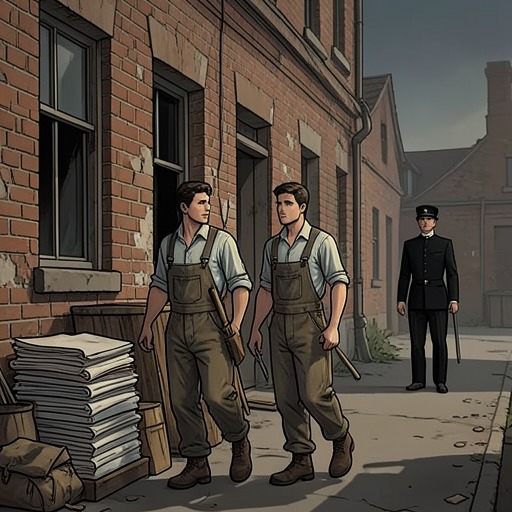
The work ranges from ordinary household moves to jobs whose purpose is less clear. The boys carry furniture up and down brownstone stairwells and use a makeshift pulley to pass sofas through third-story windows. They also move merchandise through storefront basement grates, help relocate the inhabitants of a fire-damaged factory, assemble and dismantle stages for the Atlantic Antic, and empty an electronics showroom after its gates have been opened for them. Frank brokers these tasks through relationships and favors; clients watch the boys for signs of theft or disloyalty, while the boys watch them in return. They learn to keep what they see to themselves, and to collect information even when Frank has not explicitly made that the assignment.
The company is not merely a workplace. The boys’ shared employment changes their standing at the Home and helps them close ranks against hostility, including at Sarah J. Hale High School. Their work under Frank brings them into the older, tacitly governed neighborhood around Court Street, where the barbershop, businesses, favors, and social obligations make economic exchange inseparable from local relationships. L&L’s first business therefore teaches both practical labor and a code of observation: the boys move goods, but they also learn who is connected to whom and what remains unspoken.
From Movers to Investigators
After Frank returns to the boys’ lives, he hands them a new card: L&L Car Service, available around the clock, without a slogan or the brothers’ names. The change brings a new practical demand. The boys have no learner’s permits, so Frank takes them to the Department of Motor Vehicles and proposes limousine-operator licenses. He also tells them that the car service is a front: L&L is a detective agency. The distinction is central to the organization’s operation. A plausible transport business supplies a public identity, while the actual work includes surveillance and investigation.
The office on Bergen Street gives that dual purpose a fixed address and visible routine. A Formica counter divides the room; a television plays in the waiting area, and telephones, file cabinets, and a computer stand beneath a large laminated map of Brooklyn. Frank has marked the neighborhoods with ride prices, from five dollars to Brooklyn Heights to higher fares for more distant parts of the borough, with Manhattan and airports costing twenty dollars or more. The map and rates make the car-service identity legible as a business, while the telephone log, files, and surveillance equipment support the agency’s other work. After Frank’s death, his writing in the log, his bitten sandwich, and the cigarette butts he left behind make the office feel organized around an absent center.
The agency’s ordinary investigations give the Minna Men a defined role. They follow spouses, watch employees suspected of stealing or falsifying accounts, and use cameras and bugs to gather evidence for reports. Under Frank, these cases allow them to understand the small dramas of Cobble Hill and Carroll Gardens and to build a private record of neighborhood life. Their position is neither that of ordinary movers nor that of independent detectives: Frank directs their movements, and the boys learn by being placed inside situations whose larger purpose he may not explain.
The Clients and the Limits of the Work
A second, more dangerous stream of assignments comes from Matricardi and Rockaforte, referred to as The Clients. Their influence is felt in the organization’s behavior as much as in explicit instructions. When their interests appear to be involved, Frank changes his habits: he stops visiting familiar neighborhood places, closes the storefront, sends the boys away, chooses restaurant seats with his back to a wall, and watches the street. His joking becomes more broken and his silences more pronounced. The work itself is similarly discontinuous. Instead of complete, understandable investigations, the boys receive fragments of larger affairs, acting as tools on the edges of stories they cannot see whole.
The contrast exposes the limits of L&L’s apparent authority. In its neighborhood cases, the boys gather information and produce reports that they understand as complete. On assignments connected to The Clients, they follow instructions without knowing what the evidence is for or what consequences may follow. One early example sends them to guard an empty Volvo on Remsen Street until a tow truck is supposed to arrive at five. The truck does not come at five, or six, or seven; as the wait stretches into evening, an otherwise inconspicuous car becomes the center of their anxious attention. L&L can deploy its men and keep watch, but it cannot explain the larger transaction to them.
The Yorkville Zendo stakeout likewise shows the agency working outside its familiar territory. Lionel Essrog and Gilbert Coney are sent to 109 East Eighty-fourth Street without being told why. They wait in Frank Minna’s Lincoln, eating White Castle food, while doormen in neighboring buildings notice the two large, conspicuous men. The assignment’s destination lies far from the agency’s usual Brooklyn circuit, and the bronze plaque identifying the town house as the Yorkville Zendo provides a clue without an explanation. L&L’s errand system can move its workers into unfamiliar spaces, but their assignment may begin before they know what they are meant to discover.
Evidence, Betrayal, and Institutional Change
After Frank is killed, the organization’s ordinary paperwork and objects become investigative leads. Lionel returns to the Bergen Street office and circles the words WOMAN, GLASSES, and ULLMAN, DOWNTOWN in his notebook, treating these sparse entries as the first active traces of a case. Later, a rental car’s registration card identifies the Fujisaki Corporation and gives the address 1030 Park Avenue; Lionel calls L&L to have Loomis search records on the building and its management. The shift is telling: the business infrastructure that once coordinated Frank’s errands now helps Lionel turn scraps of information into investigative steps.
The investigation also reveals how the agency’s assignments connect to the property and service work associated with the Yorkville Zendo. Gerard Minna explains that his students performed maintenance and service labor in the building as part of their training, while the contract for those services was worth millions. Frank’s brother and Ullman diverted most of the difference into their own pockets, and Fujisaki sent the giant after Frank and the bookkeeper. This disclosure makes the organization’s history of moving, servicing, watching, and carrying out errands newly significant: L&L’s work had brought its members close to operations whose financial and personal stakes they did not understand.
The company’s final reorganization is deliberately modest in appearance. L&L remains a detective agency, but for the first time a clean one; it has no clients. It also becomes a genuine car service, accepting calls unless the cars are actually unavailable. Danny Fantl has flyers and new business cards printed, promoting economy and efficiency across the boroughs. The Lincoln in which Frank died is cleaned and put back into service as part of a small fleet making regular runs between local destinations, including the Cobble Hill Nursing Home and the Promenade Diner. The change does not erase the agency’s past, but it alters what its daily work means: transportation is no longer simply a cover, and detective work is no longer bound to the hidden demands of The Clients.